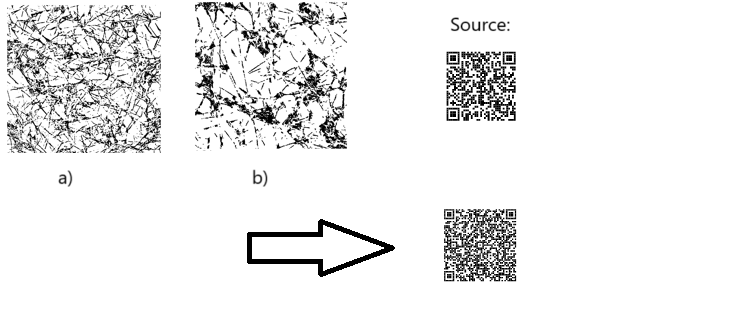
Compensation of 4D CT noise and motion artifacts
• 4D CT in industry can leverage time redundancy to improve resolution.
• Generative AI can reduce noise and motion artifacts.
• Synchronization with object movement can further refine image quality.
• Reconstruction methods that use past and present data can enhance accuracy.
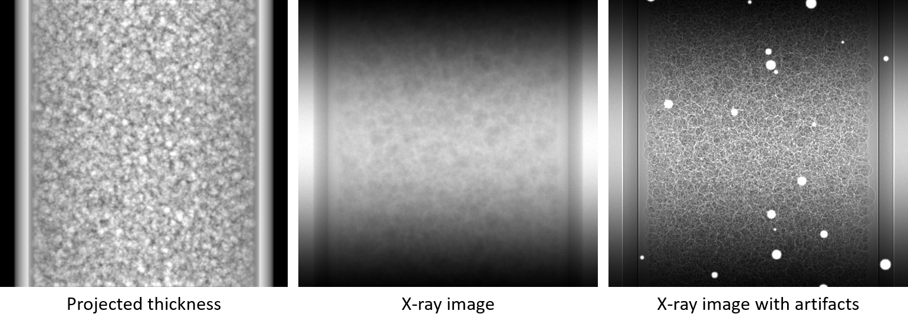
Generation of 4D CT datasets using simulation
•Dynamic simulation of time-resolved tomography
•Flexible imaging process with multiple measurement conditions
•Allows testing of new image processing algorithms
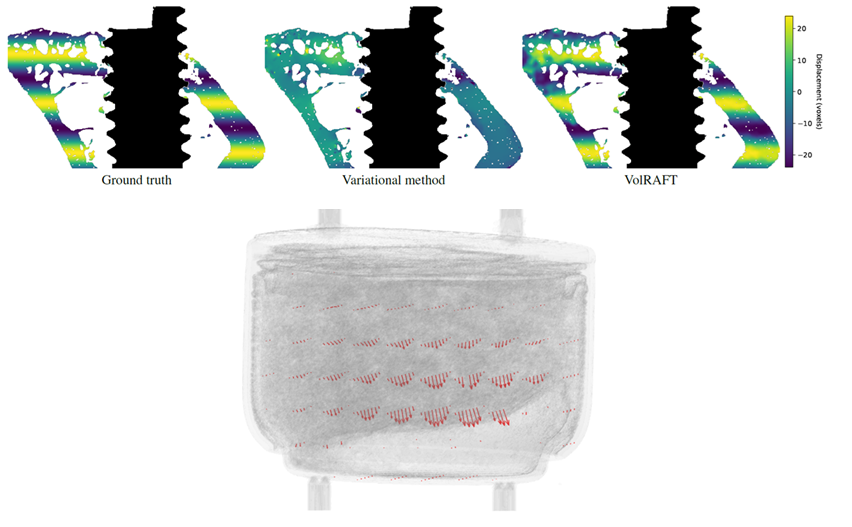
μ-CT digital vol. correlation & volumetric optical flow
•VolRAFT is trained for micro-CT data of bone-implant interfaces.
•VolRAFT can outperform variational optical flow method.
•Evolution of Zink-air battery neutron scan is efficiently captured by dense volumetric optical flow computation.
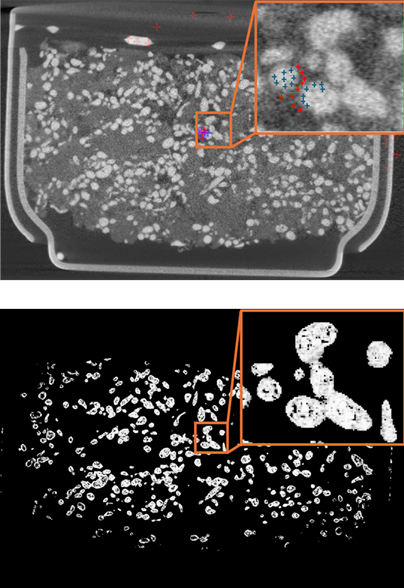
Interactive data-driven segmentation
The segmentation of datasets has always been a vital part of many image or volume processing applications, especially regarding tomography data. Common approaches nowadays use either manually tuned methods or rely on techniques like Deep Learning.
However, such methods often are useful for segmenting only components of a certainly well-defined type which mostly suffices for clinical data but not for industrial applications anymore.
In order to overcome these limitations we propose an interactive approach to volumetric segmentation encompassing robust classifiers and localized volume processing. The resulting algorithm is flexible enough to be used for a broad variety of different segmentation tasks while still generating high quality results.
The local processing further enables the segmentation of larger volumes which cannot be handled by existing applications.
Compression for archiving of 4D tomography data
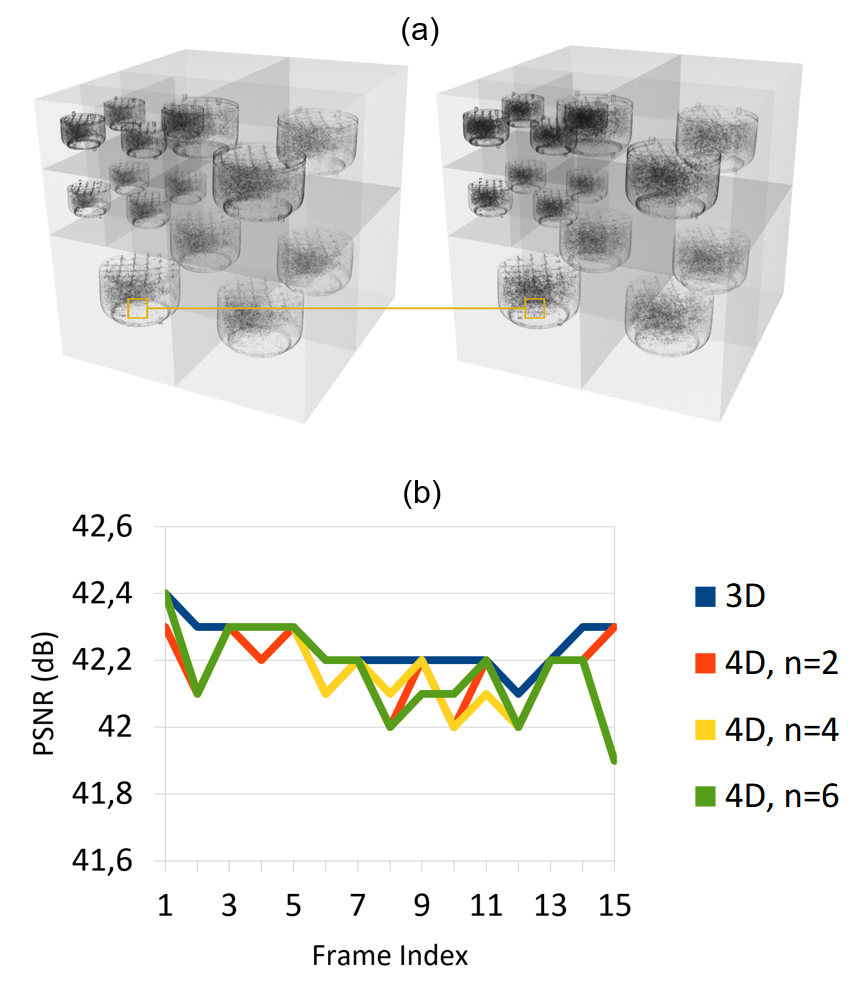
Given a 4D dataset, consisting of 3D volumetric data for every time step (“frame”), we introduce a heuristic to calculate “suitable” differences of the 3D frames: First, we select every n-th frame as “keyframe” which are compressed individually. In between, the compression algorithm decides locally which keyframe (past or future) is to be used asreference for the difference calculation to reduce compression artifacts.
- The plot (b) shows resulting PSNR values for each frame for independent 3D and time-dependent 4D compression (for n=2,4,6), applied to the discharging zinc-air battery dataset (3D compression ratio: ~63, 4D compression ratio: ~73 with n=2).
- The above image (a) illustrates a coefficient-wise comparison of two wavelet-transformed frames, with a single region highlighted.
Real time decompression of 4D tomography datasets
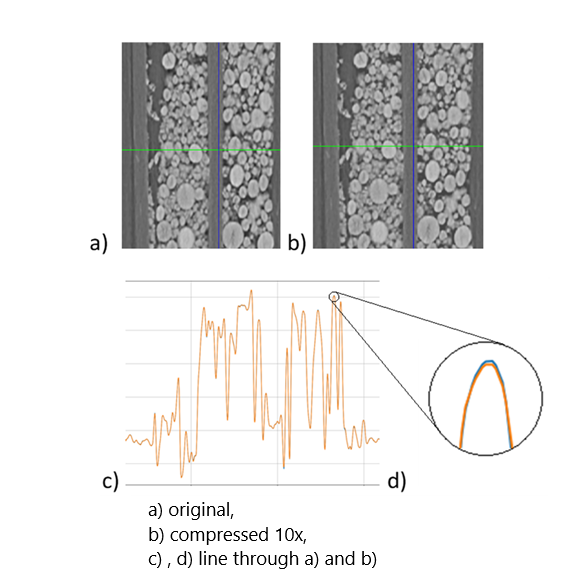
•Data in memory is compressed
•Each 16x16x16 block compressed separately
•Decompression on-the-fly during visualization
•5-10 MPixel/s on AMD 7900X3D (12-core, 4.4GHz)
Processed 4D synchrotron data for NN training
•Quality of classification of 4D data requires high quality training data
•A multimodal, multidimensional characterization approach is used for precise quantification
•Ground truth and training data for improved quantification accuracy and training of NNs is created
Application: dynamic water content analysis
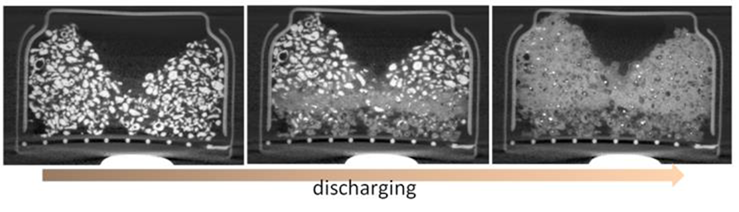
•Accuracy of BESSY synchrotron images (a) for ML was better than such from a nano-CT-device (b).
•Dynamic water content analysis,
until now only in 2D: