
An AI-based framework for the visualization and analysis of massive amounts of 4D tomography data for end users of beamlines
The basic concept of the KI4D4E software framework is to keep the large volumes of 4D tomography data in compressed blocks in the computer’s main memory for visualization and analysis, so that a 1–2 terabyte dataset, with a compression factor of 10, can be accommodated in the 128 GB or 256 GB main memory of a PC. This framework makes visualization and analysis available to end users of beamlines without the need of a server with over one terabyte of main memory. Below, two videos made on a laptop – being even less powerful than the PC – moving through the 3D slices or the timesteps of a 4D tomography dataset in real time.
Using lossy compression according to the JPEG standard with a factor of 10 results in such minimal data loss (close to visual lossless compression) that these losses are negligible for visualization and further analysis. When accessing a 2D slice of the entire volume data set, only the relevant data blocks are decompressed fast enough in real time. In Fig. 3 a series of time steps are shown in agreement with the video of Fig. 2.
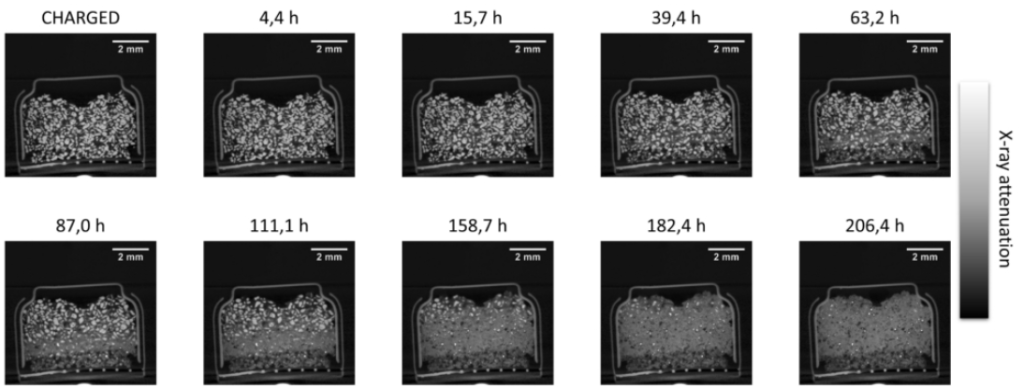
Fig 3: The 4D in-situ/operando X-ray tomography of a commercial zinc-air battery shows the dissolution of the zinc particles during discharge. Photo: Helmholtz-Zentrum Berlin (HZB), Tobias Arlt, Ingo Manke.
For quality improvement through AI-based artifact compensation and for AI-based analysis of the volumetric data, neural networks are integrated via the software framework, and users can integrate their own networks. Examples of artifact types that have been integrated include noise, metal artifacts, and motion artifacts. Examples of AI-based analysis include neural networks for segmentation or for the extraction of objects such as pores or other objects. In summary, the project aims to improve image quality through artifact reduction, reduce data volume, and make the data available to end users to assist them in interpreting the results. A good overview of the project is provided in the following publication:
S. Kieß, T. Lang, T. Sauer, A. M. Stock, A. Chernov, Y. Sun, A. Maier, T. Faragó, A. Ershov, G. Lefloch, G. Silva, T. Baumbach, S. Zabler, A. Hölzing, K. Dremel, A. R. Durmaz, A. Thomas, I. Manke, N. Kardjilov, T. Arlt, T. M. Wong, R. Willumeit-Römer, J. Moosmann, B. Zeller-Plumhoff, D. Froning, S. Simon, A Framework for the AI-based visualization and analysis of massive amounts of 4D tomography data for end users of beamlines,e-Journal of Nondestructive Testing, vol. 30, iss. 2, 2025, doi:10.58286/30717
The resulting methods is applicable to data generated by both photon and neutron sources. The project is funded by the BMFTR under grant number 05D2022.